

- One of the oldest pilgrimage trails in Japan. Inscribed on the UNESCO World Heritage list, and covered on foot as it always has been.
- 4 walking days. From 2 hours to a short full day, 200 to 500 metres of ascent depending on the day.
- Kumano Hongu Taisha. One of the most important shrines on the pilgrimage, reached on foot on the fourth day.
- Nachi and its waterfall. The most visual moment of the route, on the fifth day.
- Yunomine Onsen. A night in a ryokan with baths, where the legs ask for it.
- Nights in minshuku and ryokan. Often isolated, in the heart of the villages or the forest, meals included.
- Kii-Katsuura to finish. A small coastal town, its fish market and its baths.
Best placed between Kyoto and Osaka, where the route finds its full coherence.
Itinerary
Day 1 — Toward Tanabe
The sequence opens with the run down to the Kii peninsula: 2 hours from Osaka, 2h40 from Kyoto, on the Kuroshio express. A quiet day, mostly logistical.
On arrival, there is time to settle in and prepare what comes next, including buying the following day’s lunch: the options are thin on the trail.
Day 2 — From Tanabe to Takahara
The first real day on the Kumano Kodo. A bus leads to the starting point, at Takijiri-ōji, and the walk begins straight away with a demanding climb. The stage is short — 3.7 kilometres, 2 to 3 hours — but it goes from 100 metres of altitude to 300, and most of that is in the first kilometre: uneven stone steps, roots, a few places where your hands come into it. An intense warm-up, in a dense forest, immersive from the first steps.
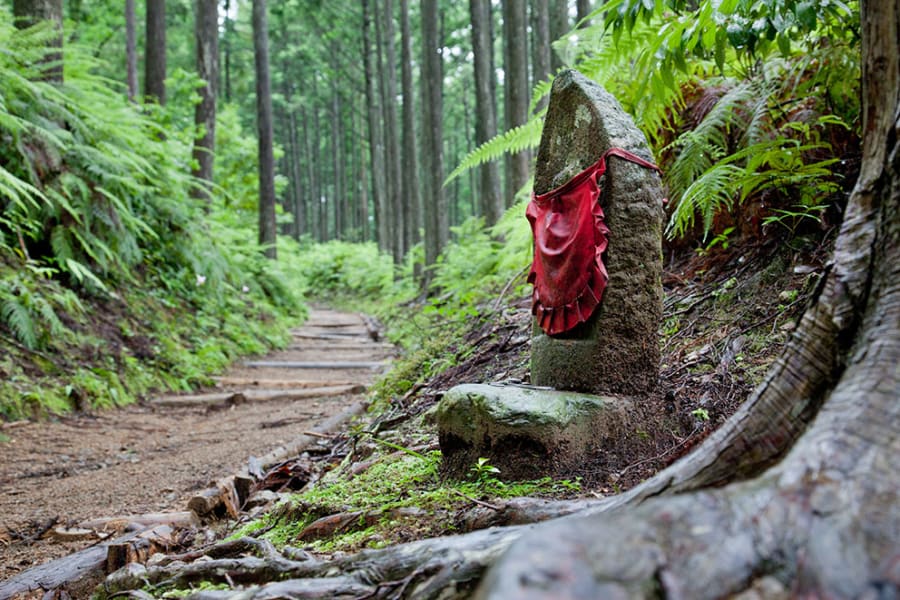
Alternative: a taxi drives straight to Takahara to avoid the climb.
Day 3 — From Takahara to Chikatsuyu
A fuller day of walking: 4 to 6 hours for around ten kilometres, and close to 500 metres of cumulative ascent — more than the day before, but spread across the day. The path climbs toward 600 metres, drops, climbs again, and alternates between forests, small isolated villages and more open stretches. This is a stage very representative of the Kumano Kodo: nature everywhere, the calm, few people.
Alternative: a taxi remains possible, but the stage then loses most of its interest.
Day 4 — From Chikatsuyu to Yunomine
A lighter day on foot, 2 to 3 hours, and almost all of it downhill: the last section starts at 300 metres of altitude and reaches Hongū at 100. It is the knees that work here, not the lungs. The high point: arriving at Kumano Hongu Taisha shrine, one of the most important sites of the pilgrimage, a cultural and spiritual stretch of time.


After the visit, a bus reaches Yunomine Onsen. The night is spent in a ryokan with an onsen: enough to recover after several days of walking.

Day 5 — From Yunomine to Kii-Katsuura
A more varied day, less continuous walking and more visits. First the Shingu area, then the Nachi region, one of the most visual moments of the trip, with Nachi shrine and its waterfall. You reach the shrine by the 267 stone steps of the Daimon-zaka, between two 800-year-old cedars: the only real climb of the day.
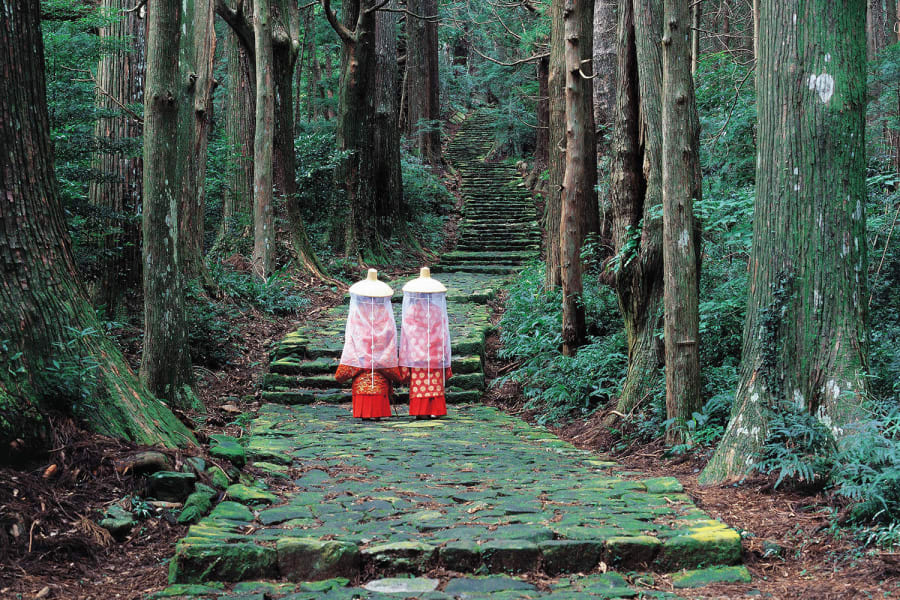


At the end of the day, arrival at Kii-Katsuura, a small coastal town known for its onsen and its fishing port. This is where the sequence closes: the night is spent in town, between the fish market and the baths, and the train leaves the next day for Osaka or Nagoya.
Our addresses
Along this route, the places to stay are deliberately varied: minshuku, lodges and ryokan out in the open country. Often isolated, in the heart of the villages or the forest, they favour the experience and the immersion over standard comfort. Meals are most often included, since there is next to no option for eating nearby, and these places play a real part in the recovery, the days being physical.
In Tanabe, a stage of transition
- Hotel Kii Tanabe. Simple and practical, close to the station, for the night before the trek.
In Takahara, the first night out in nature
- Kiri-No-Sato Takahara Lodge (“Organic Hotel”). An open view over the valley, a good level of comfort.
- Komorian. More intimate, a warm and local atmosphere.
- Hoshizora No Yado. Simple, a good balance between experience and immersion.
In Chikatsuyu, a village on the way
- Chikatsuyu Pon. Well balanced, a friendly atmosphere suited to walkers.
- Minshuku Chikatsuyu. A family atmosphere, a traditional Japanese experience.
- Guest House Chikatsuyu Sora. Simple, clean and functional.
- Sakura No Sono. A pleasant setting.
In Yunomine, for its onsen
- Yunomineso. A comfortable ryokan with an onsen, to recover after several days of walking.
- Watarase Onsen. Thermal baths, a pleasant experience.
- Guesthouse Yunosato. Simpler, and enough to make the most of the area.
In Kii-Katsuura, the coastal note
- Manseiro. An onsen and a good level of comfort, to close the Kumano Kodo.
- Kamenoi Hotel Nachi Katsuura. Comfortable and classic.
- Hotel Urashima. A large complex with many baths, more unusual.
Travel times
The Kumano Kodō crosses the Kii peninsula, south of Kansai. You come in at Tanabe, on the west coast, and leave by Kii-Katsuura, on the east: the crossing is done on foot, and the trains serve only the two ends.
| Journey | Time |
|---|---|
| Osaka → Kii-Tanabe, Kuroshio express | 2h |
| Kyoto → Kii-Tanabe, Kuroshio express | 2h40 |
| Kii-Tanabe → Takijiri (trailhead), bus | 40 min |
| Kii-Katsuura → Osaka, direct express | 4h |
| Kii-Katsuura → Nagoya, along the east coast | 3h30 |
On the route itself buses are infrequent: their timetable is set in advance, and it decides the hour you set off each morning.
Good to know
- A sequence demanding in logistics: to be placed between Kyoto and Osaka to stay coherent within the itinerary.
- Several days of walking, of varying intensity: from 2 hours to a short full day. The ascent runs from 200 metres on the first walking day to close to 500 on the second, then reverses into a descent toward Hongū.
- It is the height gain, more than the distance, that makes the difficulty: earth and stone, uneven steps, roots. Boots that hold the ankle and two poles change the day, and in the rain the stones of the path turn slippery.
- Most of the walking stages can be shortened or replaced by a taxi, according to the legs and the weather.