
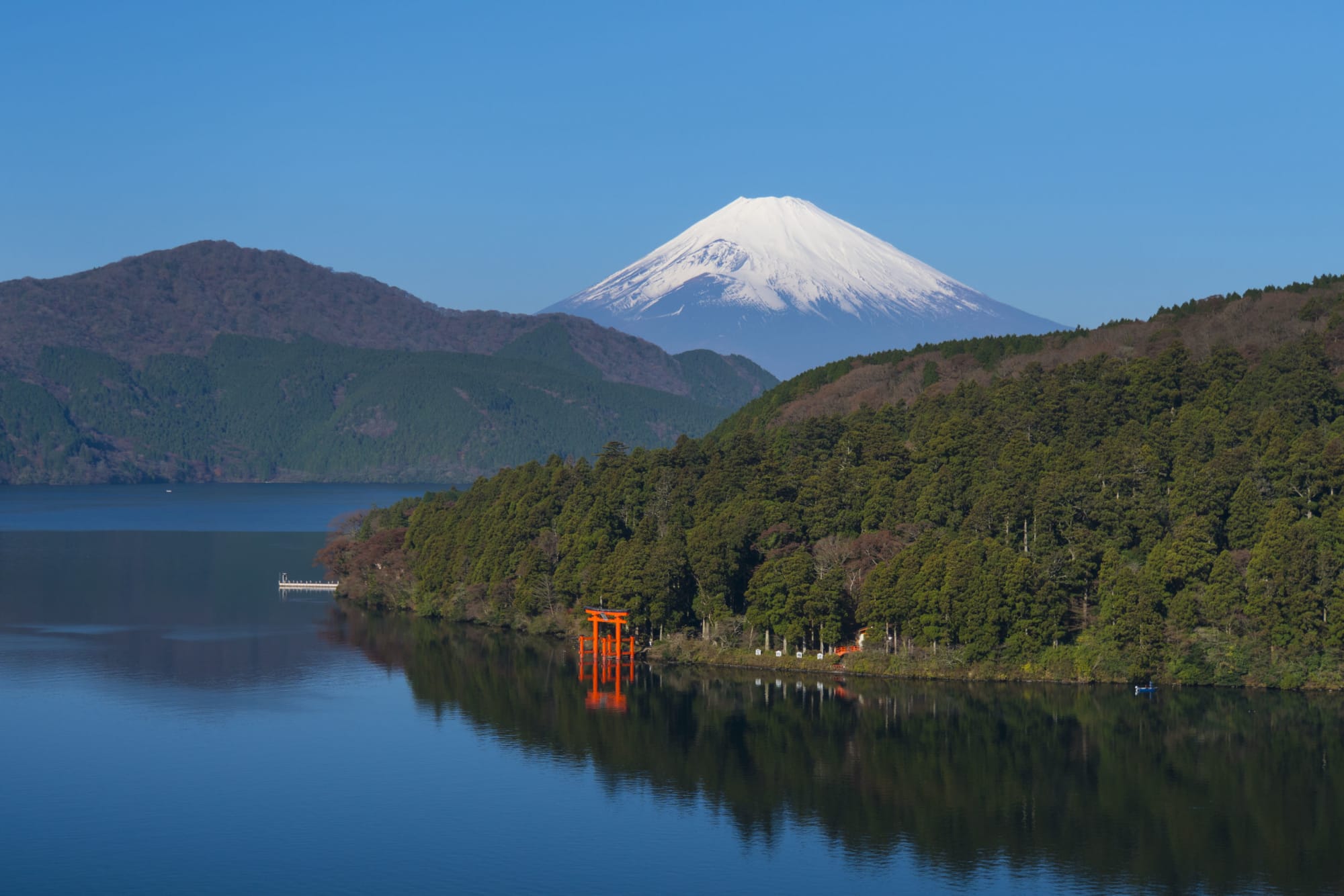
- Fuji, if it cares to show. You see it about one day in two across the year, and better before nine in the morning.
- A night in a ryokan. Tatami, the futon laid out while you eat, fifteen rooms at most and no lift in the oldest.
- The water drawn from the ground. The bath before dinner, the bath again afterwards, in a pool you can book for yourselves.
- A kaiseki dinner. A dozen or so small dishes served in order, from sesame tofu to trout from the lake, rice last.
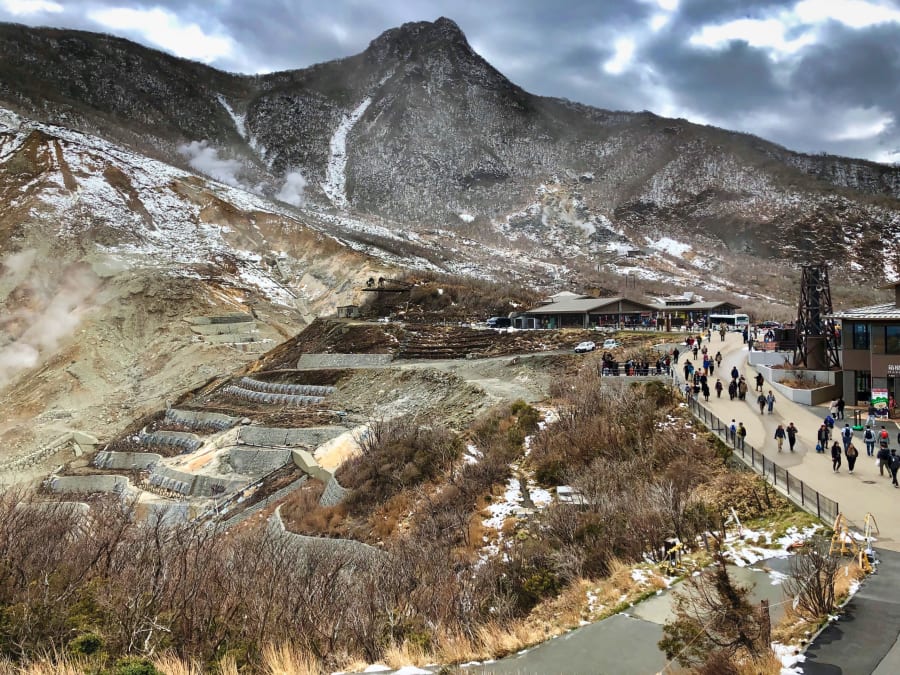
- A caldera still warm. At Ōwakudani steam comes out of the ground a few metres from the path; higher up, at Sengokuhara, the grasses stand taller than a man.
Itinerary
Day 1 — The train that reverses, the sculptures, then the plain of silver grass
The Romancecar leaves Shinjuku and takes 85 minutes; at Hakone-Yumoto you change to the mountain train, short and red, which cannot climb straight. It zigzags, and three times the driver and the conductor cross the carriage to swap places. It is a half-hour performance that children watch without saying a word.
Get off at Chōkoku-no-Mori, the stop before Gōra: the open-air museum is a two-minute walk, and the mountain behind changes colour while you walk. Allow two hours, three if you sit down.
From Gōra, a bus climbs to Sengokuhara in twenty-five minutes. The slope there turns to grass taller than a person, silver from October to the end of November; the path runs through it and takes an hour, up and back down. Come in late afternoon: the sun passes through the stems from behind and the plain lights up all at once. The wind never quite stops, and it is the only sound.

The bus comes back down to Miyanoshita in half an hour. The ryokan takes the rest of the day: the bath before dinner, dinner, the bath again afterwards.
Day 2 — The valley that steams, and Fuji if the sky allows
Leave early: Fuji shows best before nine, before the air thickens.
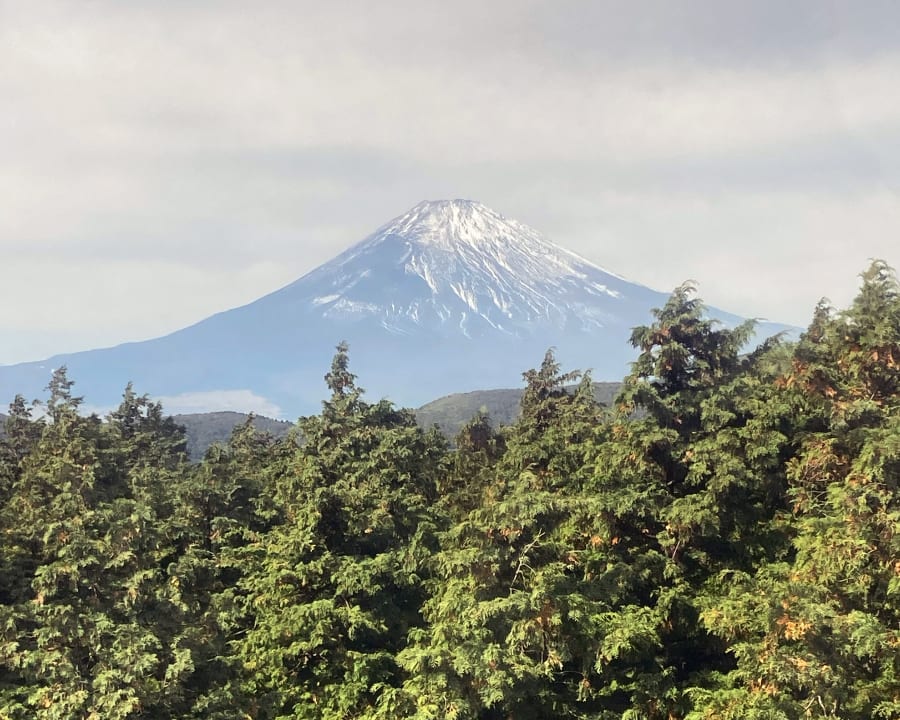
The funicular climbs from Gōra to Sōunzan in ten minutes, at roughly the pitch of a staircase. Ten minutes of ropeway further on, the cabin tips out over Ōwakudani.

It is not a summit, whatever you may read, but a valley, opened some three thousand years ago when a flank of Mount Kamiyama gave way.
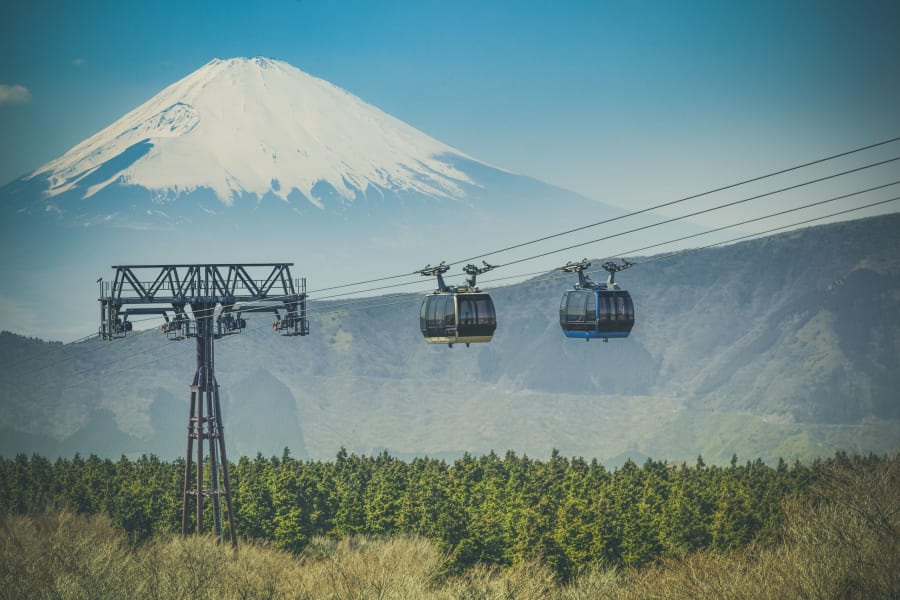
The descent to Lake Ashi takes some twenty minutes, the cabin facing north-west: this is where Fuji appears if it is going to appear.
At Tōgendai the boat crosses to Moto-Hakone, its torii standing in the water, its shrine higher up under the cedars. Then five hundred metres of the old Tōkaidō, and the bus.
Our addresses
A ryokan with its own spring, in the Yumoto valley or higher up towards Miyanoshita. We keep three or four, all of them small, all with a bath you can book for yourselves by the hour.
The oldest has walls darkened by a century of steam and no lift. The newest holds eight rooms, all facing the river, and serves dinner at one hour only. We will tell you which suits you, depending on what you prefer: the patina or the quiet.
Travel times
Everything starts at Shinjuku, and almost everything that moves in Hakone is run by the same company, which is what makes the loop so simple.
| Journey | Duration |
|---|---|
| Tokyo (Shinjuku) ↔ Hakone | 1h25 |
| Odawara ↔ Hakone | 15 min |
| Kyoto ↔ Hakone | around 2h30 |
Door to door: the Romancecar leaves Shinjuku and runs to Hakone-Yumoto without a change. From Kyoto or Nagoya, the shinkansen stops at Odawara and the valley train covers the last fifteen minutes. Once inside the caldera, everything is taken without a thought: the mountain train, the funicular, the ropeway, the boat, the bus — half an hour at most from one point to the next.
What comes next. The shinkansen stops at Odawara: Tokyo is half an hour east, Kyoto a little over two hours west. Hakone slots in as easily at the start of a journey as in the middle, a breath between two cities. Westwards, the Kiso valley and the Nakasendo are three and a half hours away, one change at Nagoya; the Japanese Alps four and a half by the same line.
Good to know
- Fuji cannot be ordered in advance. From Hakone you see it roughly one day in two across the year: two days in three in midwinter, fewer than one in five in July and August. Leave early, and treat the appearance as something extra rather than as the programme.
- Ōwakudani can close. The volcano is monitored continuously, and a rise in gas levels is enough to suspend the ropeway and access to the valley. The circuit is then done by coach as far as the lake: you lose the steam, you keep the day.
- Hakone fills up at weekends, and in November when the maples turn. On a weekday the mountain train and the boat are taken without queueing.