
- Two nights on the island. Enough to cross it without hurrying, and to find the quiet of the shore in the evening, once the day visitors have taken the ferry back.
- The Tadao Ando museums. The Chichu, buried in the hillside; Benesse House, museum and hotel at once.
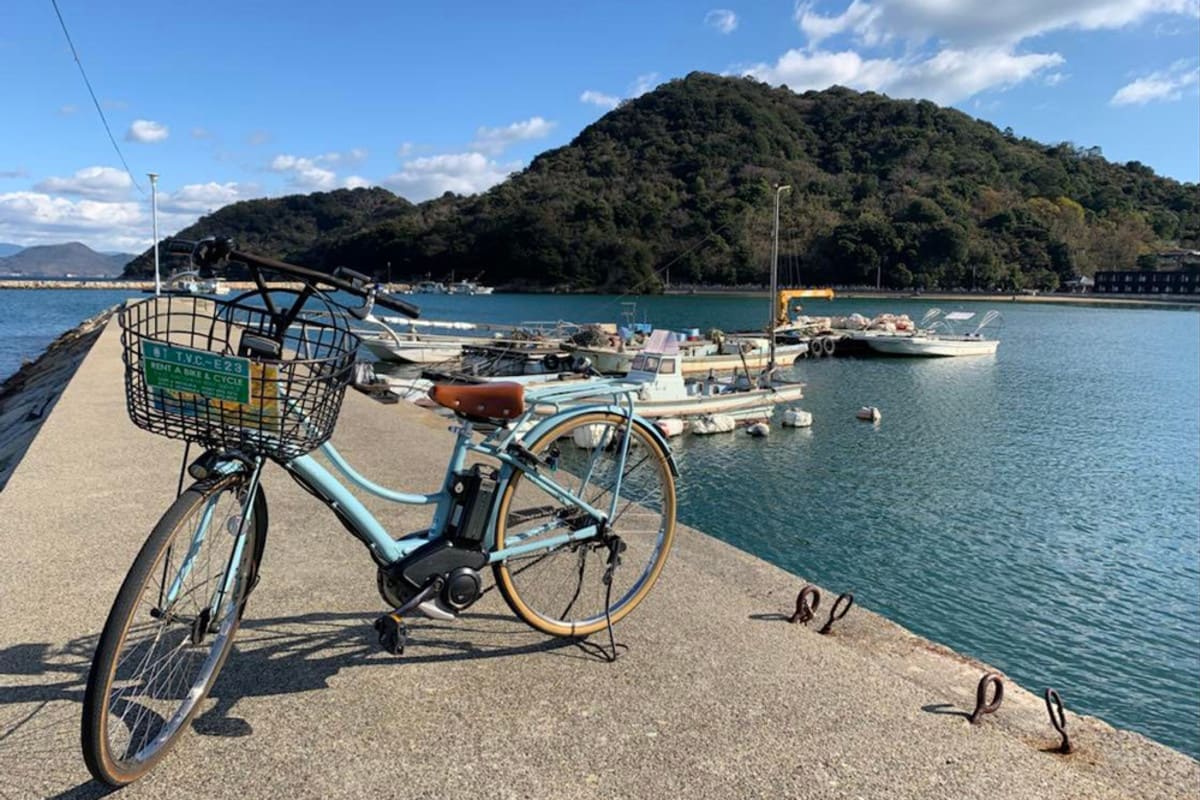
- The bicycle. The simplest way to link the sites: the distances are short, and you shape the day as you like.
- The outdoor installations. Set straight into the landscape, between the beaches and the small villages.
- I Love Yu. A public bath turned into a work of art: you do not look at it, you bathe in it.
- Arriving by sea. Twenty minutes of ferry from Uno, and the rhythm slows the moment you land at Miyanoura.
The island
Naoshima made its name through its contemporary art museums and its open-air works, built directly into the landscape. The island was largely developed by the Benesse foundation, with several museums by the architect Tadao Ando.
The feel is calm, almost Mediterranean: beaches, small villages, a relaxed atmosphere. You come as much for the art as for the pause it offers.
By bicycle, at your own pace
Here, everything is discovered freely. The bicycle is the simplest way of linking the sites, and the distances are short. Nothing is imposed: you shape the day to the mood.
Among the places that make the island:
- Benesse House. Museum and hotel at once, the emblematic place on Naoshima.
- Chichu Art Museum. A museum buried in the hillside (booking often necessary).
- Lee Ufan Museum. The barest of them: stone, steel, concrete, and few rooms.
- Ando Museum. Quicker, as a complement.
- I Love Yu. A public bath turned into a work of art, to be used.
Itinerary
Nothing is imposed, and that is what makes Naoshima. But if three days had to be sketched out, two nights on the island:
Day 1 — Arriving by sea, and the village of Honmura
The ferry slides toward Miyanoura and, from the port onward, the rhythm changes: slower, lighter. You pick up the bicycles at the landing — electric ones, since the island climbs and drops — then drop the bags before setting off.
The afternoon is for Honmura, the village on the far side, a quarter of an hour by bicycle. Old wooden houses there have been handed over to artists, one by one: you go in through the original door, into what was a home, a workshop, a temple. Nothing to book — a single ticket is sold in the village, and you visit the houses in whatever order you like.
Late in the afternoon, the day visitors take the ferry back. The light drops, the quay empties, and the island belongs only to those sleeping on it.
Day 2 — The large museums, from one end of the island to the other
The day goes to the large museums, the ones that ask for a booking and a little time ahead of you. The Chichu first, buried in the hillside, where the daylight does all the work. Then the Lee Ufan, a few bare rooms around a gravel courtyard. Then Benesse House, museum and hotel at once, which closes later than the others.
From one museum to the next, the road runs along the sea and the open-air works mark out the way: you stop when you want, and set off again the same way.
In the evening, I Love Yu, a public bath turned into a work of art: you undress, you wash, you get into the water — the one work on the island you come out of with wet hair.
Day 3 — The coast, the beaches, then the ferry
The morning stays free, and deliberately so: the coast and its coves, a beach where you do nothing, the works you skipped the day before, the Ando Museum if you have not seen it yet. You return the bicycle at the port before boarding.
Twenty minutes of ferry to Uno, a train to Okayama, and there you pick up the Sanyō line again, east or west.
Our addresses
What is on offer is limited on the island and deliberately simple: little time is spent in the room, the essential is lived outside, by bicycle. What counts is the location and the practicality.
The signature stay is a recent, comfortable address, well placed for reaching the museums, often with a fine view, the right balance between comfort, situation and the spirit of the island.
On request, it is also possible to stay at Benesse House, the museum-hotel designed by Tadao Ando: an experience apart, where you sleep in the heart of the art.
The precise choice of lodging is settled with you, according to your wishes and your budget.
Travel times
Everything goes through Okayama, then the port of Uno: the island sits in the middle of the Inland Sea, between Honshū and Shikoku, and is taken on the way along the Sanyō line. Since Okayama is on the shinkansen, the island is within reach of Kansai and Hiroshima alike.
| Journey | Time |
|---|---|
| Kyoto or Osaka ↔ Naoshima | around 3h |
| Hiroshima ↔ Naoshima | around 3h |
Door to door: the shinkansen to Okayama, the local train to the port of Uno, then twenty minutes of ferry to Miyanoura. Leaving, you go back through Okayama and pick the line up again either way: Kyoto to the east, Hiroshima to the west. From Shikoku, a direct ferry links Takamatsu to the island in fifty minutes.
Good to know
- Not to be placed on a Monday or a Tuesday: several museums close, and the side trip loses much of its interest.
- The Chichu and a few other museums ask for a booking, the bicycle too: we arrange them ahead.