

- The Genbaku Dome. What is left standing of a 1915 building, on the bank of the Motoyasu. A grave stretch, and one you have to leave room for.
- Okonomiyaki. The Hiroshima speciality, built up in layers and cooked in front of you on the griddle. From November to March, with oysters from the bay.
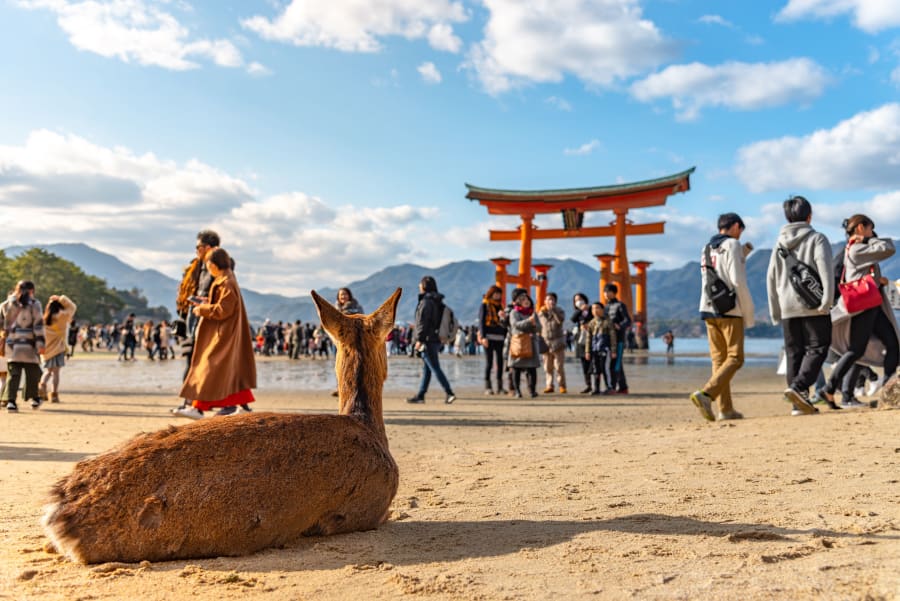
- The great torii of Itsukushima. Vermilion, set on the sea. At low tide you walk out over the sand to its feet; the island’s deer do not stir for so little.
- A shrine on stilts. Built in 593. The island being sacred, you were not allowed to set foot on it: hence the structure standing over the water.
- The ceiling of Senjō-kaku. A vast timber pavilion left unfinished in 1587, whose beauty is read by looking up.
- Daishō-in. Buddhas and stone figures scattered through the gardens, at the foot of Mount Misen.
- Mount Misen. On foot or by ropeway, as you feel. At the top, the bay and its islands set one behind the other; in November the maples join in.
- The night on the island. The last ferries leave loaded, and only those sleeping there remain.
Best placed on the Sanyō line, west of Kansai. Hiroshima is taken heading down from Kyoto or Osaka, or coming up from Kyūshū.
Itinerary
Day 1 — Hiroshima, the river and the park
You arrive by the Sanyō: 1h40 from Kyoto. Fifteen minutes by tram, and the Genbaku Dome is there, on the bank of the Motoyasu. A building from 1915; the bomb went off six hundred metres above it, almost vertically. The frame held.

The museum opens at 7.30am. That is the hour we recommend: the park is still empty, the light comes off the river. Allow two hours, and plan nothing straight after.


In the afternoon, the Shukkeien, a garden of 1620 razed on 6 August and reopened in 1951. In the evening, okonomiyaki: cabbage, noodles, egg, built up in layers on the griddle, in front of you.
Day 2 — Miyajima, and the night on the island
Twenty-five minutes by train, ten by ferry. The shrine opens at 6.30am: taking the first boat means seeing Itsukushima before the groups. The tide decides the morning — at low tide you walk to the foot of the torii, at high tide it floats. We set the hour by the tide table.
Then Daishō-in, its gardens peopled with statues, and Mount Misen, by ropeway or by the trail. The Reikadō, at the summit, burned down on 20 May 2026; the flame, tended for twelve centuries, was saved.


Late in the afternoon, the ferries leave loaded. What remains is the deer, and those who sleep there.
Hiroshima and Miyajima do not fit into the same day. That is the one thing this leg asks.
Our addresses
The first night is spent in Hiroshima, in town, some ten minutes by tram from the park.
The second is spent on the island, in a ryokan. That is the night that changes the leg: once the last ferry has gone, only those who sleep on Miyajima are left. The island’s houses are few, often old — floorboards that shift, shared bathrooms in the plainest of them — and they book up long in advance. The address is settled with you.
Travel times
Hiroshima sits on the Sanyō line, an extension of Kansai. You arrive heading west from Kyoto or Osaka, or coming up from Kyūshū, but not as a return trip from Tokyo, which is four hours away and has no reason to be the starting point.
| Journey | Time |
|---|---|
| Kyoto → Hiroshima, shinkansen | 1h40 |
| Osaka → Hiroshima, shinkansen | 1h25 |
| Fukuoka (Hakata) → Hiroshima, shinkansen | 1h |
| Hiroshima station → Peace Memorial, tram | 15 min |
| Hiroshima → Miyajimaguchi, train | 25 min |
| Miyajimaguchi → Miyajima, ferry | 10 min |
Miyajima therefore takes three quarters of an hour door to door, train and ferry included. On the way out, the road carries on to Fukuoka and Kyūshū (1h), to Fukuyama and Tomonoura (25 minutes), or inland to Tsuwano (2h30).
Good to know
- The Memorial Museum opens at 7.30am and costs 200 yen. The 7.30–8.30am slot requires an online booking. It closes at 7pm from March to November, 6pm from December to February, 8pm in August.
- The ferry to Miyajima costs 180 yen, plus a 100 yen island visitor tax on every crossing. Itsukushima shrine opens at 6.30am and costs 300 yen; Senjō-kaku at 8.30am, 100 yen.
- The Mount Misen ropeway runs from 9am to 4pm; from Shishiiwa station, thirty minutes of steep trail remain to the summit. On foot from Daishō-in, allow an hour and a half to two hours.
- The keep of Hiroshima Castle has been closed since 22 March 2026: the 1958 concrete structure no longer meets seismic standards. The moats and the grounds remain open.
- The Reikadō, at the summit of Mount Misen, burned down on 20 May 2026. The flame was saved and the pavilion will be rebuilt; the trails and the ropeway reopened the next day.
- Oysters from the bay are eaten from November to March, which is also the month the island’s maples turn.