

- The jōyatō on the quay. A stone lantern five and a half metres tall, over ten with its masonry base, the harbour light since 1859. Every day ends underneath it without anyone deciding it should.
- A port that still fishes. Nets spread against the walls, ice unloaded at first light, boats moored three metres from the front doors.
- The lanes of the old centre. Too narrow for two cars, lined with merchant houses and timber fronts darkened by age, best walked without a map.
- The hōmeishu. The sailors’ liqueur, sixteen ingredients of which thirteen are herbs, devised here in 1659. Four houses still make it; you taste it standing in the shop, in a small glass.
- The Taichōrō veranda. At Fukuzen-ji temple, one room opening wide onto the bay and its islands. A Korean envoy wrote here in 1711 that he had seen nothing finer to the east.
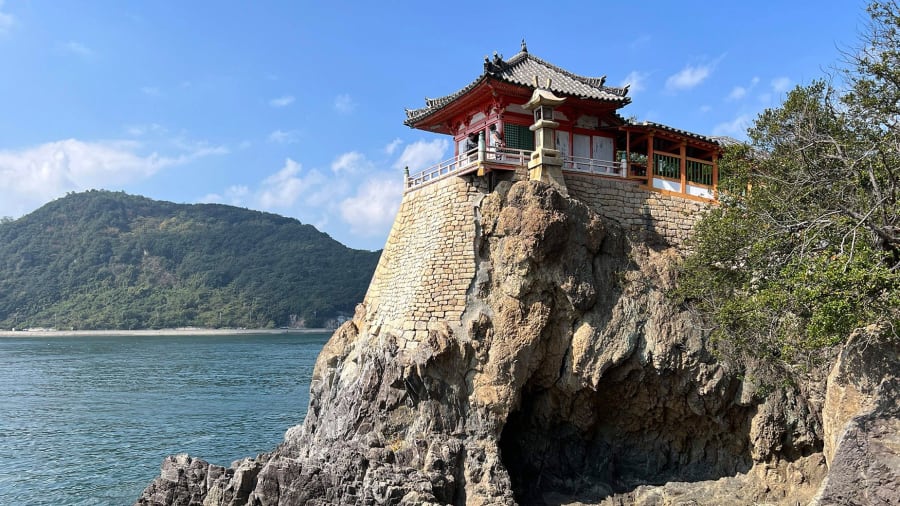
- Abuto Kannon. A vermilion hall built around 1570 on a fifteen-metre cliff, twenty minutes south. People prayed here for the sea, and for childbirth.
- Two nights in the same place. You unpack, you come back for dinner, you go out again after the bath. That is the whole programme.
Itinerary
Day 1 — Arrive, then stay put
You reach Tomonoura through Fukuyama, on the Sanyō line. On the station square the bus marked Tomonoura leaves every twenty minutes and takes about thirty to reach the coast, on a road that narrows as it goes. You get off in front of the tourist office, at the water’s edge, not at the next stop, which has almost the same name.
The inn is a few steps from the quay. The bags are already there, sent ahead by courier; there is nothing to carry, and nothing scheduled for the afternoon.
So you go out and walk. Tomonoura is very small: from the quay to the temples on the height, it all fits inside ten minutes. Ships of the age of sail waited here for the tide to turn: the Inland Sea changes direction twice a day, and you did not sail against it. The town was built on that waiting, and it has kept the rhythm.

Late in the day the sun drops behind the hill and the quay becomes the place everyone ends up. Then the bath, and dinner at the inn.
Day 2 — The day you don’t fill
Nothing is fixed before mid-morning. The lanes climb behind the port: merchant houses turned into small museums, a blacksmith’s workshop, the hōmeishu houses, four in all, that you go into for a taste and sometimes leave with a bottle. A few steps higher, the Taichōrō veranda at Fukuzen-ji temple opens in one piece onto the bay; you sit on the tatami facing the islands, and the visit lasts as long as it lasts. The room served as lodging for the Korean envoys, and one of them left here in 1711 the line the temple still hangs from its beams.
In the afternoon there are two directions, and you take one. South, twenty minutes by bus, Abuto Kannon sits on a fifteen-metre cliff that drops into the sea: the hall juts out above the water, lacquered vermilion since the 1570s. Inside, the walls disappear under votive offerings: cloth breasts, sewn and hung up by the women who came to ask for a child, or for a delivery without incident.
Or the crossing to Sensui-jima, the island facing the port: five minutes by ferry, paths climbing into the pines, a sand beach and nobody on it. The ferry shuttles every twenty minutes until half past nine at night, and you come back when you like.
Around five, the shops pull their shutters down and the village empties of its day visitors. The people sleeping here get the port to themselves. It is the best hour, and it is also why you stay two nights.
Day 3 — The port at work, then the bus
The morning belongs to the port. Around seven the boats go out or come in depending on what the tide is doing, ice is unloaded onto the quay, and the cats wait in the right spot. You watch from a distance, out of the way, with a coffee.
After that, time for one last turn round the basin, a stop at the shop for the bottle you didn’t take, and the late-morning bus back to Fukuyama.
Our addresses
Both nights are spent in the same inn in the old port, a few steps from the quay: houses of ten rooms or fewer, often family-run, with timber corridors that creak, no lift, and a view of the bay from the front rooms.
At the table it is whatever the Bingo sea sends: sea bream, which comes into the bay to spawn in early summer, small fish grilled with salt, octopus. The hōmeishu comes at the end, in a small glass. We hold the room and both dinners at booking, and ask for a room on the harbour side when the house has one, since those go first.
Travel times
Everything goes through Fukuyama, on the Sanyō line, then a thirty-minute bus. It is a dead end: you don’t pass through Tomonoura, you go to it.
| Journey | Time |
|---|---|
| Kyoto → Fukuyama, shinkansen | 1h30 |
| Osaka → Fukuyama, shinkansen | 1h |
| Hiroshima → Fukuyama, shinkansen | 25 min |
| Okayama → Fukuyama, shinkansen | 20 min |
| Fukuyama → Tomonoura, bus | 30 min |
What follows. You pick the shinkansen back up at Fukuyama. West, Hiroshima is 25 minutes away, Miyajima 35 more, train and ferry included. East, Okayama 20 minutes, Naoshima a little over an hour beyond that, twenty minutes of it on the water.
Good to know
- Tomonoura is done entirely on foot. The old centre’s lanes are too narrow for two cars, and are better covered without a map: you always end up back at the harbour.
- Tomonoura closes early. The shops pull their shutters down in the late afternoon and there is no nightlife; dinners are at the inn, and that is exactly right.
- The étape works in any season. Summer is hot and heavy on the Inland Sea; spring and autumn are the clearest, and winter here is mild and empty.
- It combines well with Naoshima, further east on the same Inland Sea, or with Hiroshima & Miyajima, an hour further west.